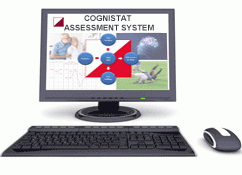
Cognistat Logo
About Translations References Articles FAQ Order Contact
Cognistat is utilzed world-wide.
What is Cognistat?

Cognistat (Neurobehavioral Cognitive Status Examination)
Developed by Ralph J. Kiernan, PhD; Jonathan Mueller, MD; and
J. William Langston, MD

This testing instrument is used globally by psychologists, physicians, and nurses. Psychologists, neuropsychologists, counseling psychologists, and mental health counselors, as well as primary care physicians, geriatricians, internists, psychiatrists, neurologists, and other health-related professionals find that Cognistat provides information essential to their evaluation and care. Ill-informed or misguided empathy creates problems for patients and caregivers. Empathy informed by information is essential to the humane treatment of cognitively impaired individuals.

A patient’s profile of specific abilities and disabilities often sheds important light on the individuals’ functional limitations. This information, in turn, can be used to counsel patients and family members, assist hospital staff who work with the patient, determine areas that may benefit form rehabilitation, and prepare appropriate discharge or travel plans.

 
Cognistat is Highly Valid

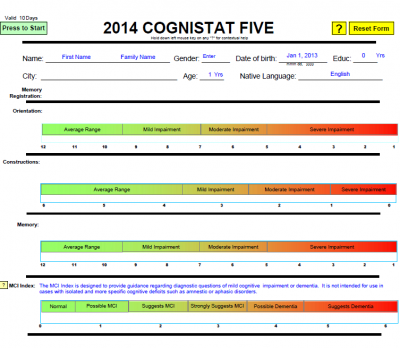
Cognistat has been found to be reliable and highly valid. It identifies patients with significant, behavior-modifying cognitive deficits more successfully than other cognitive screening instruments. A graphic representation of performance in separate cognitive domains assures that apples and oranges are not mixed. Cognitive strengths and weaknesses are highlighted.

 
Neuropsychological Thoughts


Ralph J. Kiernan, Ph.D.

Reflections on the clinical practice of a complex and challenging specialty

The Concept of Disability
Neuropsychologists are constantly faced with a complex clinical task, and they must draw upon a broad empirical data base in relating test scores to brain dysfunction. We use deductive thinking to make inferences about the brain directly from the test scores according to standardization tables. Our inferences about specific disabilities or about the brain, however, also depend upon our subjective impressions about the nature of impaired performance processes. We inductively draw upon our observations and interactions during the evaluation to guide our interpretations regarding the disabilities. The interweaving of our two basic kinds of thinking represents the essence of high quality clinical diagnostic work.
Read More >>>

The Cognistat Philosophy
Even the most minimal neuropsychological assessment must evaluate each of the basic functions known to be sensitive to brain dysfunction. The cognitive abilities assessed in the Cognistat - attention, language, constructional abilities, calculations, memory and reasoning - represent the most essential functional areas. A more thorough neuropsychological assessment would need to additionally evaluate mental tracking or sequencing, spelling, spatial memory, story paragraph memory, executive functioning, processing speed, and reading.
Read More >>>


What Cognistat Tests

What Cognistat does: Assesses intellectual functioning in five areas
For: Ages 12 years and older
Administration: Individual
Time: 10 minutes for cognitively intact clients; 20-30 minutes for those who are cognitively impaired
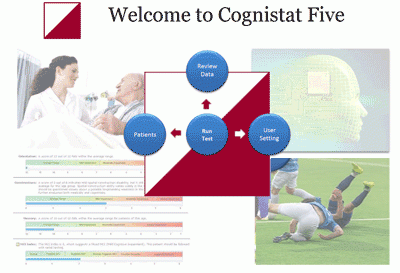
Cognistat will rapidly assess neurocognitive functioning in five major ability areas:
Language
Constructional ability
Memory
Calculation skills
Reasoning/judgment

Language has four separate subsections. This makes it possible to rapidly identify major aphasic syndromes: Spontaneous speech, Comprehension, Repetition, and Naming.
Reasoning has two subsections: similarities and judgment.
Except for memory, each section is given in an efficient screen and metric paradigm. This ensures that unnecessary time is not spent testing areas that are intact, while areas of impairment are explored in some detail. The more general areas of level of consciousness, orientation, and attention are assessed independently.

2007: A New Test Booklet, A New Manual

In a recent survey, Rabin, Barr and Burton found that Cognistat was among the top 20 most widely used test instruments employed by neuropsychologists in the United States and Canada. It was used by neuropsychologists more frequently than the Mini-Mental State Examination (MMSE). The new 2007 Manual will help you evaluate, understand and treat your patients. Our website www.cognistat.com provides periodic updates of the literature on Cognistat and its use in a variety of settings.

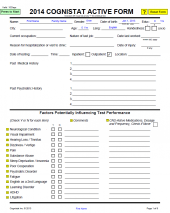
The newly-revised 2007 Cognistat Test Booklet has been strengthened by the inclusion of a new section on page 4 that systematically addresses a series of “state variables” and offers a brief Comment section for each. These state factors vary from one test situation to another and represent important “atmospheric” or “contextual” forces that can affect a patient’s performances on cognitive testing. Circling Y for yes does not mean that this factor is affecting test performance, but rather that it may be affecting test performance. While examiners who are not physicians or psychologists may feel uncomfortable interpreting the degree to which such factors have influenced a particular performance, their observations concerning the presence or absence of these state variables are an essential part of administering Cognistat.

Testing must always be interpreted within a broad clinical context. Our new section addressing state variables represents a serious attempt on our part to discourage the administration of Cognistat in a rote fashion. We wish to promote a kind of “ecological mindfulness” on the part of examiners.

The 2007 Cognitive Manual includes an extensively updated list of articles about Cognistat’s many uses in specific populations. This list will be helpful to clinicians and researchers alike. Among the clinical situations in which Cognistat has been used are the following: dementia assessments, post-surgical assessment of coronary artery bypass graft (CABG) patients, evaluations of substance abuse patients, and the assessments of driving skills. Cognistat appears to be meeting the needs of many different clinicians!

******

Rabin LA, Barr WB, Burton LA. Assessment practices of clinical neuropsy- chologists in the United States and Canada: A survey of INS, NAN and APA Division 40 members. Archives of Clinical Neuropsychology. 2005; 20:33-65.


All material on this website is the property of Cognistat ©2005.